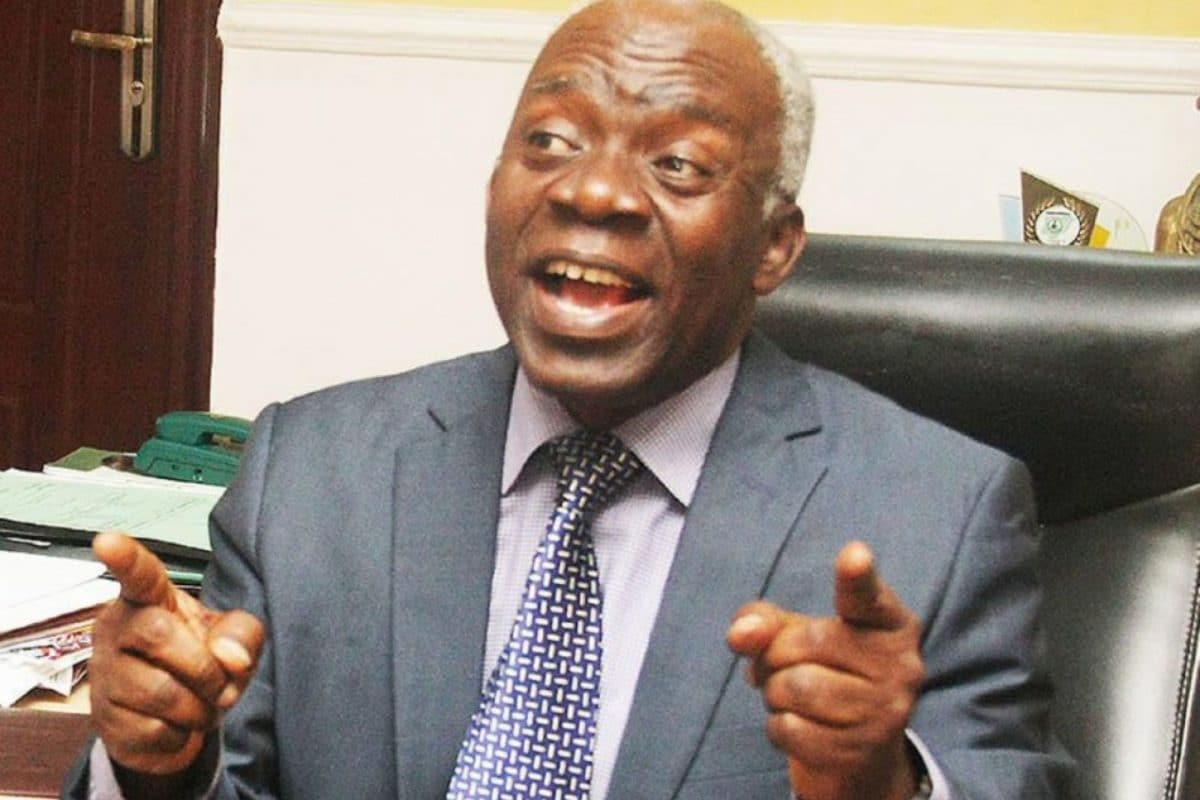
Human rights lawyer Femi Falana has called on the Nigerian government to work with other countries to exert diplomatic pressure on the United States over its role in the escalating conflict involving Iran and Israel.
Falana made the remarks during an appearance on the television programme Politics Today on Channels Television on Thursday.
According to him, Nigeria should collaborate with other nations to ensure that international law is respected and to encourage major global powers such as Russia and China to play a diplomatic role in resolving the crisis.
The Senior Advocate criticised the policies of Donald Trump, accusing him of disregarding international law and ignoring resolutions of the United Nations.
Falana said Nigeria should revive its traditional approach to multilateral diplomacy, similar to its role during the era of the Non-Aligned Movement, by working with other countries to encourage restraint in the conflict.
He also stressed the importance of persuading Russia and China to intervene diplomatically, noting that the two countries hold considerable influence over Iran.
Beyond the international dimension, Falana urged Nigeria to strengthen its domestic security framework and reduce reliance on foreign powers for maintaining stability.
According to him, Nigeria must reorganise and adequately equip its armed forces and police to ensure national security without depending on external powers.
Falana further pointed out that Nigerian troops have historically performed well in peacekeeping missions conducted under the United Nations and the ECOWAS Monitoring Group.
The lawyer also criticised the management of Nigeria’s refining capacity, questioning why the country’s four state-owned refineries remain non-functional despite billions of dollars spent on their rehabilitation.
He noted that the Nigerian National Petroleum Company Limited (NNPCL) now relies largely on the Dangote Refinery for fuel supply.
Falana’s remarks come amid rising geopolitical tensions following hostilities between the United States, Israel and Iran, which have triggered economic concerns globally.
Iran Conflict And Global Impact
The current conflict intensified after joint airstrikes by the United States and Israel targeted Iranian leadership and infrastructure in late February 2026.
Reports indicate that the attacks resulted in the death of Iran’s Supreme Leader Ali Khamenei, who was succeeded by his son Mojtaba Khamenei.
The war has continued with missile strikes by Iran against U.S. military facilities and Israeli targets across the region.
The humanitarian toll has been significant, with more than 1,300 civilians reportedly killed in Iran and over 3.2 million displaced, while Israeli strikes in Lebanon targeting Hezbollah have resulted in over 600 deaths.
At least seven American soldiers have also been reported killed during the hostilities.
Oil Prices And Impact On Nigeria
The conflict has disrupted global energy markets, especially after Iran reportedly blocked the Strait of Hormuz, a key channel for global crude shipments.
As a result, global oil prices have surged beyond $100 per barrel, prompting the International Energy Agency to release about 400 million barrels of crude oil in an attempt to stabilise supply.
The ripple effects are also being felt in Nigeria, where petrol prices have reportedly risen to between ₦1,000 and ₦1,300 per litre, before slightly dropping to around ₦1,075–₦1,165.
Meanwhile, the Nigerian government has begun evacuating citizens from the conflict zone. The Nigerians in Diaspora Commission said Nigerians in Iran are being escorted across the Armenia border, with no casualties reported so far.
However, many Nigerians remain stranded in transit hubs across the Middle East due to flight cancellations and airspace restrictions.
About The Author