
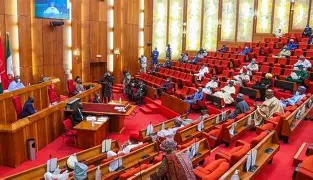
National Assembly
Nigeria has moved closer to adopting state police following the approval of a constitutional amendment bill by the Senate, marking a significant milestone in the country’s efforts to reform its security system.
The proposed legislation, which seeks to allow states to establish and operate their own police services alongside the Nigeria Police Force, secured the constitutionally required two-thirds majority during Wednesday’s Senate session.
The development is widely regarded as one of the most significant constitutional reforms since Nigeria returned to democratic governance in 1999.
With both chambers of the National Assembly now supporting the proposal, attention shifts to the 36 State Houses of Assembly. For the amendment to become law, at least 24 state legislatures must approve it before it is forwarded to President Bola Tinubu for assent.
If eventually adopted, the amendment would introduce a dual policing structure in Nigeria, allowing federal and state police agencies to operate side by side.
Under the proposed arrangement, governors would have the authority to appoint Commissioners of Police for their respective states, subject to confirmation by the State Houses of Assembly. Meanwhile, the Nigeria Police Force would remain under the leadership of the Inspector-General of Police and continue to oversee matters relating to national security.
Speaking during deliberations on the bill, Senate Leader Opeyemi Bamidele explained that the framework was carefully designed to provide states with greater control over local security while preserving national unity and coordination.
According to him, state police formations would be responsible for enforcing state laws, maintaining public order, protecting lives and property, and tackling security challenges within their jurisdictions.
The federal police would continue to focus on issues such as terrorism, organized crime, cybercrime, border security, arms trafficking, and other offences with national implications.
Lawmakers also introduced safeguards aimed at preventing potential abuse of state police powers. One of the key provisions states that state police authorities cannot arrest, detain, investigate, or use force against individuals, political parties, or groups solely because they criticize government actions, except where permitted by law.
In addition, the National Assembly would retain oversight responsibilities by setting minimum standards for recruitment, training, discipline, accountability, and operational procedures for state police services across the country.
Supporters of the reform argue that locally recruited officers would possess a better understanding of the language, culture, and security dynamics of their communities, thereby improving intelligence gathering and crime prevention efforts.
They also contend that state governments, which already invest heavily in security operations, should have greater authority over policing activities within their territories.
The proposal has received backing from several security experts and regional security organizations, including the Western Nigeria Security Network, popularly known as Amotekun.
Officials of the outfit have expressed confidence that the South-West region is well-positioned for a successful transition to state policing, arguing that decentralized security structures would enhance efforts to tackle kidnapping, banditry, and other criminal activities.
Despite growing support, concerns remain among critics who fear that state police could be exploited by some political leaders to intimidate opponents or influence electoral processes.
Nevertheless, the Senate’s approval represents a major breakthrough in the long-running debate over policing reforms in Nigeria.
As consultations move to the state assemblies, political observers and security stakeholders will be closely monitoring developments. The outcome of the process could determine whether Nigeria embraces one of the most transformative changes to its security architecture in modern times.
About The Author