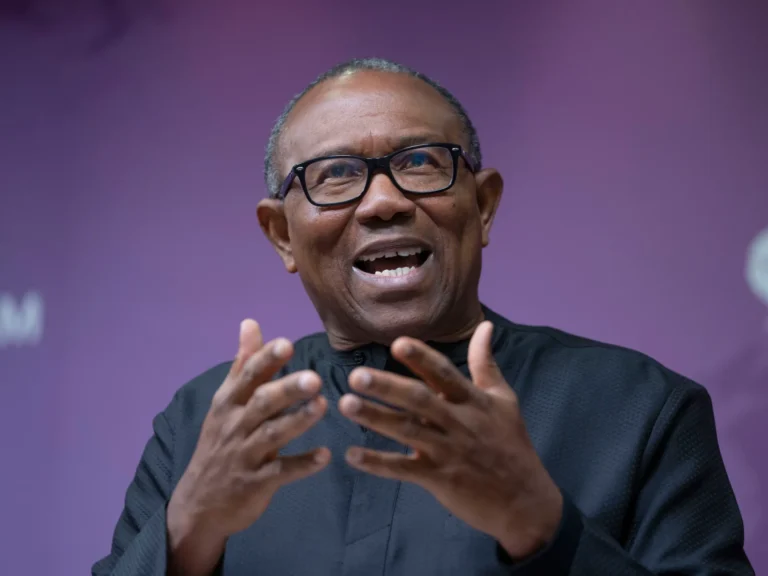
Former presidential candidate, Peter Obi
With political conversations increasingly turning toward the 2027 general elections, former Anambra State Governor and Nigeria Democratic Congress (NDC) presidential candidate, Peter Obi, has declared that he remains confident of electoral success even without the backing of state governors.
Speaking during an interview with NoireTV, Obi dismissed suggestions that the growing support President Bola Ahmed Tinubu is receiving from governors across the country would significantly influence the outcome of the next presidential election. According to him, political endorsements from governors are less important than the support of ordinary Nigerians who are grappling with economic hardship and seeking meaningful change.
“It doesn’t matter whether 36 governors are with the president. I didn’t have one governor in the last election, and I won 12 states,” Obi said.
The former presidential candidate argued that his performance in the 2023 election demonstrated that electoral victories can be achieved without the support of powerful political structures. He maintained that despite what he described as irregularities during the election, he was still able to secure victories in several states across the federation.
“Even after they have stolen two from me, I won 12 states. By making Abuja a state, we now have 37 states, because that is what the judgment of the Supreme Court showed,” he stated.
Obi further noted that Senator Rabiu Musa Kwankwaso won Kano State, while the APC, PDP, and Labour Party each recorded victories in 12 states. He insisted that he would have secured additional states if not for what he alleged were electoral manipulations.
Beyond the issue of electoral numbers, Obi stressed that the 2027 election should focus on improving the lives of Nigerians rather than political alliances and elite power plays. According to him, the major concerns of citizens today revolve around poverty, hunger, healthcare, education, and economic opportunities.
“So it doesn’t matter whether they took all the governors. What is important, and what this election is going to be all about, is how to make Nigeria work for the poor,” he said.
The former governor also reiterated his vision of a country where ethnicity, religion, and tribal affiliations no longer dominate political discourse. He argued that leadership should be evaluated based on its ability to improve the welfare of the people.
“The issue will be about the welfare of the people, the education of the people and the health of the people. That’s the Nigeria we want. Nigerians are hungry today. Nigerians are looking for food,” Obi added.
In a related development, Obi has pledged to adopt dialogue and engagement as key tools for addressing the various agitations and divisions across the country.
According to a statement issued by the Peter Obi Media Reach (POMR) and signed by spokesman Ibrahim Umar, the former governor made the remarks while interacting with Nigerians in Washington, D.C. During the engagement, he was asked how he would address growing regional tensions and strengthen national unity.
Responding to the question, Obi said he would prioritize listening to aggrieved groups and seeking common ground through constructive dialogue.
“To achieve the aim of unifying the country, I will listen to all agitators, harmonise them and make some sacrifices with a view to bringing the country together,” he said.
The statement explained that Obi believes many of the agitations across Nigeria stem from poverty, unemployment, exclusion, and perceptions of injustice. It added that his position should not be interpreted as support for any specific group but as a commitment to addressing the root causes of unrest through peaceful engagement.
The media office further emphasized the importance of dialogue in nation-building, stating that, “True national unity cannot be coerced; it must be built.”
As political alignments and strategies continue to evolve ahead of the 2027 elections, Obi’s comments provide a glimpse into the message he hopes will resonate with voters. By focusing on welfare, inclusion, and national unity, the former governor appears determined to present himself as a candidate whose campaign is driven by the needs of ordinary Nigerians rather than the endorsement of political heavyweights.
About The Author